Reaching back to the beginning of the atomic age brings us
to the beginning of World War II. If
there is distress when one considers who and why would someone work on nuclear
weapons in our time, it pales before what the responses to these questions were
if posed in 1939. Europe fractured with
the onset of World War II as Hitler invaded Poland. One of the most accomplished physicists that
has ever walked the Earth remained to work in Nazi Germany. To this day this physicist’s motivation and
role in the Nazi regime's attempt to develop an atomic bomb is as mysterious and paradoxical
as the quantum physics that he developed.
A recent article (Ref. 1) in Optics and Photonics News
summarizes what is known and not known about Werner Heisenberg’s motivation and
actions.
The Nazi party concocted “Jewish Physics”, persecuted its presumed
practitioners, and then substituted “Deutsche Physik” (German Physics) in its
laboratories and universities. Through
odd historical coincidence and his proven abilities, the persecution of the
entirely Aryan physicist Werner Heisenberg (1901-1976) for his supposed collaboration with
Jewish Physics was halted. The head of
the SS, Heinrich Himmler (1900-1945) had attended the equivalent of elementary school with
Werner Heisenberg. Their mothers were familiar enough so that Heisenberg’s
mother was able to appeal to Himmler through Himmler’s mother on Werner
Heisenberg’s behalf. His primary tormenters, Johannes Stark and Philipp Lenard
(both Nobel physics prize laureates and ardent Nazis) lost much of their
influence within the Nazi hierarchy after Himmler’s intervention. (Ref. 7)
 |
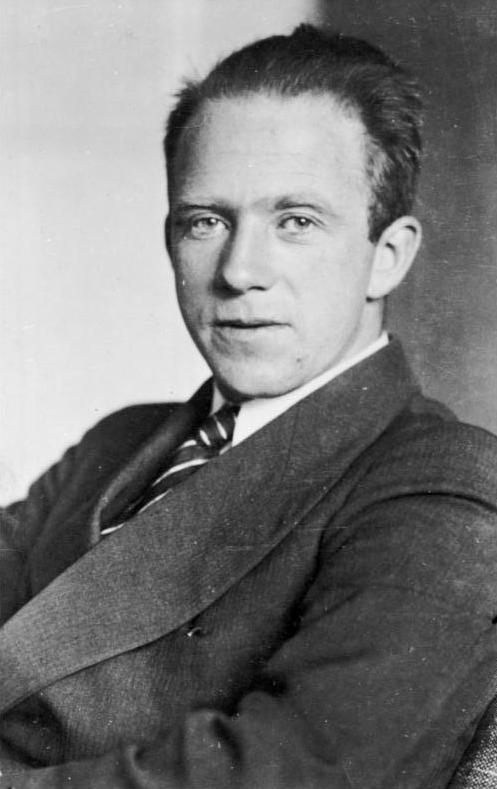
| Werner Heisenberg in 1933 http://upload.wikimedia.org/wikipedia/commons/f/f8/Bundesarchiv_Bild183-R57262,_Werner_Heisenberg.jpg |
Heisenberg himself demonstrated savvy political and survival
skills as he initiated a full character investigation of himself by the Nazi
party which he passed. Himmler
personally banned any further attacks on him. Himmler gave Heisenberg permission to teach
and discuss modern physics in 1938 provided he didn’t mention the names of any
Jewish physicists. (Ref. 7)
 |
| Werner Heisenberg Later in Life http://www.atomicarchive.com/Images/bio/B61.jpg |
If Heisenberg could be stereotyped as a naïve, scared,
introverted genius, oblivious in his total immersion in his specialty, his role
in the Nazi war machine would be easier to understand. This is unequivocally wrong. Heisenberg was a deep philosophical thinker
(Ref. 3, 5), politically skilled and connected in Germany, and quite aware of
the political climate around him. If
anything, he was a hardened cynic, having watched Europe persist in one
political folly after another, accompanied by the largest scale wars the world had
seen. He believed that democracy was
obsolete and would be replaced worldwide by German or Soviet domination. In his mind the home grown evil was the
lessor of the evils. Even so, without
his skill, reputation and social connections he might have perished in the
frenzy of persecution. One can only
speculate what was going through his mind as the exodus and finally
incarceration and execution of colleagues took place.
 | |
| German heavy water production plant in Norway which produced heavy water for the German nuclear effort until it was destroyed by the Allies. http://en.wikipedia.org/wiki/File:Vemork_Hydroelectric_Plant_1935.jpg |
 |
| Destruction of the heavy water plant by Allied bombing http://cdn.damninteresting.com/wp-content/uploads/2007/06/vemork_damage.jpg |
The German physics organization was formidable. Germany had been the world center of physics
before the war. Germany boasted 25 Nobel
Prize Laureates before Hitler came to power.
Nuclear fission was discovered in Germany. However, the German nuclear project
floundered and only achieved a successful chain reaction by the end of World
War II. The German project started in
1939, well before the Manhattan project which began in 1941. The Manhattan project achieved a successful
chain reaction by the end of 1942. The
“Jewish Physics” that had been denigrated and purged from the German
universities triumphed in exile.
 |
| The first page of the January 1939 Naturwissenschaften article in which the discovery of fission is announced by German scientists. Lise Meitner (1878-1968) the female Jewish physicist is cited but not credited for her contribution to the discovery of nuclear fission. http://www.aip.org/history/mod/fission/fission2/09.html |
Extensive efforts have been made to understand how far the
German effort could have gotten, how far it did get before the war ended, and
what the motivations of the elite scientists and engineers really were in this
effort. These efforts started
immediately after the war and has continued to the present time. Much of the motivations of the scientists
involved still remains a mystery.
 |
| Drawings by Werner Heisenberg made to illustrate nuclear fission process during his tenure in the World War II German nuclear program http://www.pbs.org/wgbh/nova/military/nazis-and-the-bomb.html |
 | ||
| Allied Soldiers Dismantling a German Nuclear Pile 1945 http://en.wikipedia.org/wiki/File:German_Experimental_Pile_-_Haigerloch_-_April_1945.jpghttp://en.wikipedia.org/wiki/File:German_Experimental_Pile_-_Haigerloch_-_April_1945.jpg |
The earliest unsuccessful effort at unraveling this took
place in 1945 when ten prominent captured German scientists (three Nobel
Laureates including Heisenberg) were interned at a house in England. They were interned there for six months and
the house they stayed in was secretly wired for sound. (Ref. 12,13) Although the question was raised by the
occupants within three days of whether the house was bugged, candid
conversations were recorded. An
“official” statement on the nuclear program was drafted by the scientists, but
the real motivation of “Operation Epsilon” as it was called by British and
American intelligence agencies was to spy on the scientists to discern their
true motivations and knowledge about nuclear weapons.
 |
| First page of an early report on results from Project Epsilon in which ten prominent captured German scientists were interned in a house outfitted with secret microphones http://www.paperlessarchives.com/wwii-operation-epsilon.html |
 |
| Farm Hall House in Godmanchester, England where Project Epsilon took place http://en.wikipedia.org/wiki/File:FarmHallLarge.jpg |
 |
| Museum replica of a German nuclear pile. The uranium was formed in cubes instead of rods http://historum.com/european-history/43848-german-nuclear-program-wwii.html |
Speculation on the failure of the German bomb program has
yielded many good reasons, factual and hypothetical. Lack of consistent and unconditional
government support is factual (Ref. 5, Ref. 8) and the most important single
factor. There were many reasons given
for the relative lack of support for such a formidable technology. The leaders of the Nazi party were arrogant
and overconfident. They believed that
the war would be over by 1942. Even the
most enthusiastic of the scientists knew that the development effort for a
nuclear device or nuclear power would be a long and expensive effort. The Germans wanted to invest their resources
in efforts that would have a quicker result and be available to help win the
war before it was over. (Ref. 8, 10 and 11)
 |
| Schematic drawn by German scientists of a nuclear pile http://www.pbs.org/wgbh/nova/military/nazis-and-the-bomb.html |
The German scientists themselves did not work together very
well. Heisenberg reported that many of
the scientists were more concerned with their personal prestige and controlling
funding than achieving any progress on nuclear development. There were several well documented feuds,
such as between Walther Gerlach and Abraham Esau when Gerlach replaced Easu as
the head of German nuclear research. (Ref.
10) The surprise of the German
scientists over how well the Americans were able to work together is apparent
in the August 6, 1945 Farm Hall tapes. (Ref. 12,13)
 |
| First page of a letter from Albert Einstein to President Roosevelt exhorting him to pursue a nuclear technology development program. http://en.wikipedia.org/wiki/File:Einstein-Roosevelt-letter.png |
The United States spent 26 billion dollars in 2013 dollars
and employed over 130,000 people to successfully develop the atomic bomb. (Ref. 11) The German effort consisted of about 100
people, and they spent about 13 million dollars in 2013 dollars. (Ref. 11) It is certain that the German effort was too
small to succeed, but for several twists of historical fate the Germans might
have chosen to mount a much larger effort. The nightmares of our fate in the recent era
of mutually assured destruction with the Russians are dwarfed by the fate of
the world had the Nazis been the first to develop nuclear weapons.
References
1) Bukowska,
Danuta; Maliszewska, Sylwia Bohr, Heisenberg and the Atomic Bomb
Optics and Photonics News, October 2013
Optics and Photonics News, October 2013
2) Jungk,
R.; Brighter Than a Thousand Suns—A
Personal History of the Atomic Scientists, Harcourt (1956)
3) Heisenberg,
W.; Physics and Beyond: Encounters and
Conversations, Harper and Row (1972)
4) Powers,
T. Heisenberg’s War: The Secret History
of the German Bomb, Knopf (1993)
5) Rhodes,
D. The Manhattan Project: Making of the
Atomic Bomb, Simon and Schuster (1995)
6) Heisenberg,
W.; Physics and Philosophy: The
Revolution in Modern Science Harper
Perennial Modern Classics (May 8, 2007)
7) Wikipedia,
Deutsche Physik
8) Wikipedia, German Nuclear Energy Project
10) Easley,
Matt, http://www.vanderbilt.edu/AnS/physics/brau/H182/Term%20papers%20%2702/Matt%20E.htm
11) Rose,
Paul Lawrence. Heisenberg and the Nazi Atomic Bomb Project: A Study in
German Culture. Berkley and Los Angeles: University of California Press,
1998.
12) Operation Epsilon: The Farm Hall
Transcripts, with an introduction by Sir Charles Frank (Bristol and
Philadelphia: Institute of Physics Publishing; Los Angeles: University of
California Press, (1993)
13) The Difficult Years Farm Hall Transcripts
August 6, 1945 http://www.aip.org/history/heisenberg/p11a.htm
14) Wikipedia,
Manhattan Project, http://en.wikipedia.org/wiki/Manhattan_Project